
News

Earth today, Jupiter tomorrow: An insight into Juice’s recent Earth flyby
On 28 September, ESA’s Juice mission reached another important Jupiter-bound milestone with its penultimate gravity assist manoeuvre: a flyby of Earth. This encounter, however, was not only an essential step on the road to Jupiter, but an opportunity to rehearse the observations and operations that will define Juice’s exploration of the Jovian system.
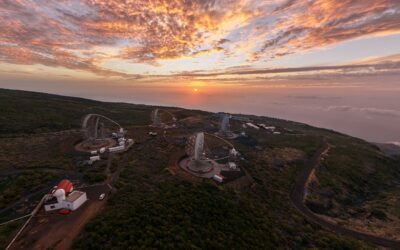
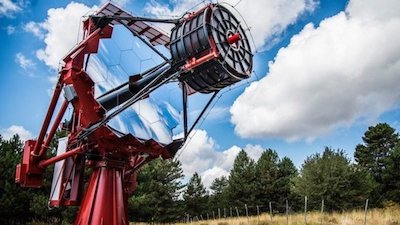
The Large-Sized Telescope Sub-Array is Inaugurated on CTAO-North
La Palma, Spain, 15 October 2026 – Two hundred and fifty scientists and representatives from leading research institutions around the world celebrated the inauguration of the Large-Sized Telescope (LST) sub-array at the CTAO-North site at the Roque de los Muchachos...

ASTRI-Horn is back in the spotlight
After a major upgrade and calibration phase, the ASTRI-Horn prototype on Mount Etna has proven to be a highly successful instrument. In addition to the scientific results achieved, the telescope has confirmed the validity of the technologies employed, which are also used by the ASTRI Mini-Array and the SST telescopes of the Cherenkov Telescope Array Observatory (CTAO). It will soon be used as a testbed for the study of volcanoes through Cherenkov muon observations.
Events and Seminars

In occasione della Notte Europea dei Ricercatori 2026, l’INAF-Osservatorio Astrofisico di Catania ha organizzato varie attività per il pubblico che ...
Come rivoluzionare la conoscenza del Cosmo grazie ai Quantum Tools. Dagli strumenti di calcolo Quantistico come la Quantum Fourier Transform ...





MEDIA INAF Il notiziario online dell’Istituto nazionale di astrofisica
- Tira aria di tempeste solari, attorno ai buchi neri
 by Giulia Mantovani on October 22, 2026 at 1:58 pm
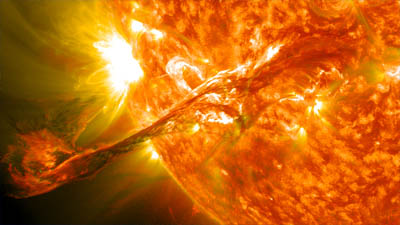
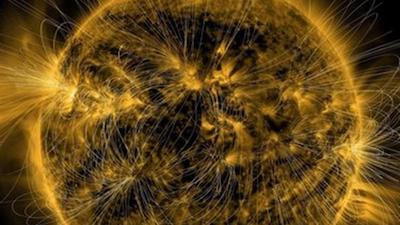
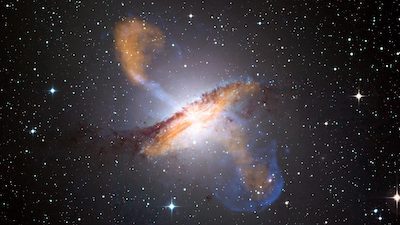
I telescopi spaziali Xrism e Xmm-Newton hanno rilevato per la prima volta l’impronta di un’eruzione da riconnessione magnetica e dell’effetto Neupert attorno a un buco nero supermassiccio nella galassia Ngc 3783, dimostrando che il meccanismo responsabile delle tempeste solari è lo stesso che alimenta i violenti brillamenti nelle corone dei nuclei galattici attivi.
- Così nascono i getti dei buchi neri supermassicciby Valentina Guglielmo on October 22, 2026 at 8:17 am
Le osservazioni a raggi X, radio e millimetriche della galassia attiva 3C 120 rivelano le condizioni che permettono a un buco nero supermassiccio di alimentarsi rapidamente e generare potenti getti di plasma. I risultati aiutano a chiarire il ruolo del plasma caldo e dei campi magnetici nella formazione dei getti relativistici. Lo studio è pubblicato su The Astrophysical Journal Letters
- Come l’intelligenza artificiale cancella le nuvoleby Federica Duras on October 21, 2026 at 4:31 pm
Si chiama GeoCore-9B ed è un nuovo modello di intelligenza artificiale sviluppato al Kaist, in Corea del Sud. Addestrato su dieci milioni di immagini satellitari e relative descrizioni, riesce a ricostruire i paesaggi nascosti dalle nuvole e a trasformare i dati radar in immagini simili a fotografie


Juice: la Terra oggi, Giove domani
www.media.inaf.it
La manovra di flyby sulla Terra compiuta il mese scorso dalla sonda Esa Juice per sfruttare il nostro pianeta come fionda gravitazionale e instradarsi correttamente verso Giove, complice una lunga ecl...
Ctao-Nord: inaugurato il sub-array degli Lst
www.media.inaf.it
Duecentocinquanta tra scienziati e rappresentanti delle principali istituzioni di ricerca hanno celebrato a La Palma l’inaugurazione del sottosistema di quattro Large-Sized Telescope (Lst) del sito ...Subscribe to our mailing list
Contatti
Osservatorio Astrofisico di Catania
Via Santa Sofia 78, 95123 Catania, Italia
(+39) 095.7332111
segreteria.direzione.oact@inaf.it
(PEC): inafoacatania@pcert.postecert.it
Per informazioni sul nostro sito: web.oact@inaf.it
Per informazioni sulla didattica e divulgazione: divulgazione.oact@inaf.it