
The ASTRI-Horn telescope, built as part of the ASTRI project at the INAF “M.C. Fracastoro” observing station in Serra La Nave, on the slopes of Mount Etna (Sicily, Italy), is the first Cherenkov telescope (IACT) to implement the innovative dual-mirror Schwarzschild-Couder optical configuration, coupled with a compact optical camera based on silicon-based sensors (SiPM) developed by INAF. The telescope was named after Guido Horn D’Arturo, the Italian astronomer, father of tessellated mirror technology for astronomical telescopes, to whom the recent conference “Mosaic Telescopes – Technology and Science” (Bologna, January 26-27, 2026) was dedicated.
Between 2020 and 2022, the facility underwent a major overhaul and upgrade. A recent study, published in the journal Publications of the Astronomical Society of the Pacific and led by INAF, details the improvements made. These improvements included the use of new reflective optical coatings (optimized to capture Cherenkov light while reducing background noise) on the primary mirror segments, camera enhancements, and a revamp of the control and data acquisition software, as well as refinements to the Monte Carlo simulations and the first tests of machine learning algorithms for shower analysis.
To verify its new performance, ASTRI-Horn observed the “standard candle” of gamma-ray astrophysics: the Crab Nebula.
The observations, conducted between late 2022 and early 2023, revealed the source with good significance in approximately 20 hours of selected data. The analysis also allowed the nebula’s energy spectrum to be reconstructed up to 10 TeV, a result in excellent agreement with previous measurements made by networks of Cherenkov telescopes such as MAGIC and H.E.S.S.
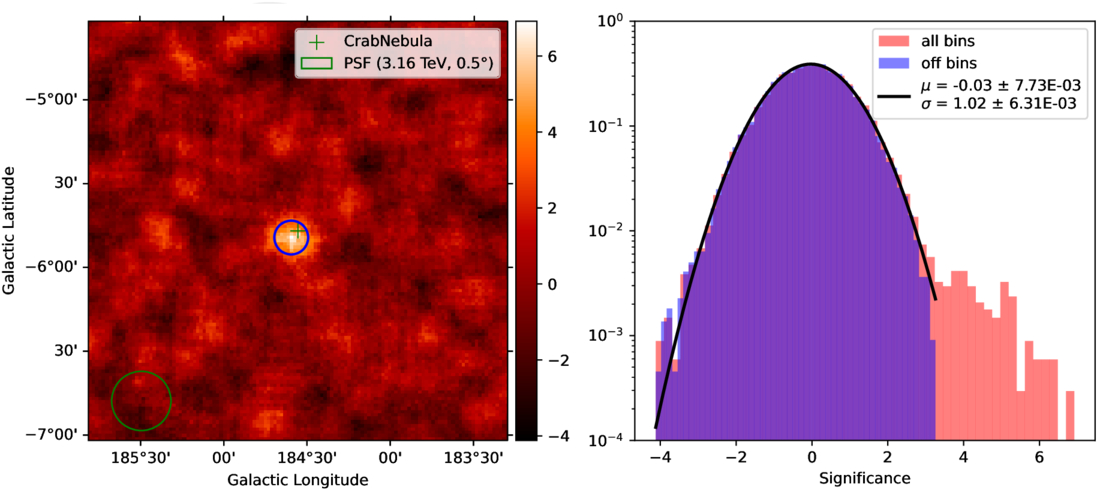
Adapted from G. Leto et al. paper: the Crab Nebula observed by ASTRI-Horn
A fundamental testbed for the ASTRI Mini-Array and the CTAO SSTs
The results obtained are not only a milestone for this telescope alone, but also represent a key point for the future of very high-energy astrophysics. ASTRI-Horn’s observing campaign has enabled the entire data acquisition, simulation, and analysis chain to be verified.
These technologies, developed with significant Italian contribution, form the construction and operational basis of the ASTRI Mini-Array dual-mirror telescopes, composed of nine telescopes currently under construction at the Teide Observatory in Tenerife (Canary Islands, Spain), and of the future small-scale telescopes (SSTs) for the southern site of the Cherenkov Telescope Array Observatory (CTAO) in Chile.
Furthermore, the experience gained on Etna in extreme environmental conditions—including fumes, volcanic ash, and large temperature fluctuations—has provided valuable lessons to ensure future telescopes have unprecedented durability and reliability. This experience will be further enhanced in the coming months, thanks to the European PN RIC program CTA++, with the refinement of volcano observation with muon showers. ASTRI-Horn thus confirms itself not only as an excellent technological prototype, but also as a mature scientific instrument, which, thanks to its modularity, can easily be reproduced on the larger scale of the next generation of very high-energy gamma-ray telescopes.
Source: astri.inaf.it
- The results are published by Publications of the Astronomical Society of the Pacific in the paper: “The ASTRI-Horn Cherenkov Telescope: Technical Assessment and Calibrations Following its Refurbishment for the ASTRI Mini-Array and CTA-SST Pathfinder” (G. Leto, C. Bigongiari, M. Capalbi, O. Catalano, V. Conforti, G. Contino, A. Compagnino, S. Crestan, F. Gianotti, A. Giuliani, S. Iovenitti, S. Lombardi, M. C. Maccarone, T. Mineo, D. Mollica, G. Pareschi, F. Pintore, P. Sangiorgi, F. G. Saturni, S. Scuderi, G. Sironi, G. Sottile, G. Tosti, G. Bellassai, P. Bruno, M. Corpora, C. Gargano, S. Garozzo, V. Giordano, F. Incardona, F. Lo Gerfo, D. Marano, E. Martinetti, A. Micciché, G. Nicotra, A. Segreto, R. Z. Sanchez, L. A. Antonelli, G. Cusumano, E. M. de Gouveia Dal Pino, O. Fedorova, F. Fiordoliva, S. Gallozzi, N. La Palombara, F. Lucarelli, A. Stamerra, S. Vercellone, A. Wolter, C. Arena, P. Bambhaniya, U. Barres de Almeida, L. Bilardello, A. Bharathan, Markus Böttcher, G. Bonnoli, A. Bulgarelli, F. Casaburo, Y. Chen, A. Costa, F. D’Ammando, R. Della Ceca, D. Falceta-Goncalves, A. Franceschini, S. Germani, A. La Barbera, D. J. Maheso, E. Molina, K. Munari, A. Pagliaro, O. Petruk, J. C. Rodríguez-Ramírez, M. Rigoselli, P. Romano, G. Romeo, S. Spinello, A. Sunny, and H.-S. Zhang2026, PASP 138 085001 – DOI 10.1088/1538-3873/ae8478)