

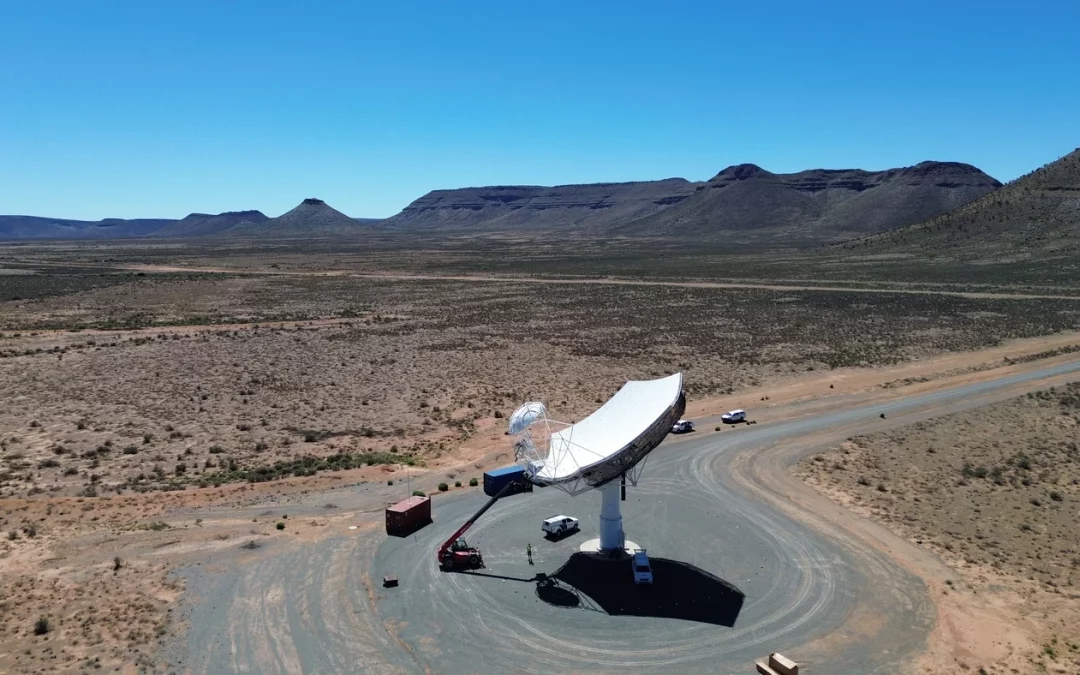
MeerKAT+: the MeerKAT Extension
The handover of the first dish of the MeerKAT extension signals an important milestone for the SKA-MID construction

ESA’s Cheops helps unlock rare six-planet system
A rare star system with six exoplanets has been unlocked with the help of ESA’s Cheops mission. The discovery is particularly valuable because the planets’ orbital configuration shows that the system is largely unchanged since its formation more than a billion years ago.

PLATO Science in Italy: ready to data exploitation?
From 25 to 27 September, the INAF-Astrophysical Observatory of Catania will host a workshop dedicated to PLATO, the 3rd mission of class M in the ESA Cosmic Vision program. Its main goal is detecting terrestrial planets in the habitable zone of solar type stars. With...
Solar Orbiter closes in on the solution to a 65-year-old solar mystery
A cosmic alignment and a little bit of spacecraft gymnastics has provided a ground-breaking measurement that is helping solve the 65-year-old cosmic mystery of why the Sun’s atmosphere is so hot.

The densest Neptunian ever observed
Its name is Toi-1853b and it is extremely peculiar: every 30 hours it completes one complete revolution around its star (the Earth takes a year to complete one complete revolution around the Sun), it has a radius comparable to Neptune’s (3.5 Earth radii, hence...
First eclipse binary system discovered in NGC 2232
By combining the photometry of the TESS space telescope with the high-resolution spectroscopy of HARPS-N (TNG), a team of researchers, led by Antonio Frasca of the Osservatorio Astrofisico di Catania, has discovered a low-mass eclipsing binary system, the first in the...
Cheops shows scorching exoplanet acts like a mirror
Data from ESA’s exoplanet mission Cheops has led to the surprising revelation that an ultra-hot exoplanet that orbits its host star in less than a day is covered by reflective clouds of metal, making it the shiniest exoplanet ever found.

Cheops explores mysterious warm mini-Neptunes
ESA’s exoplanet mission Cheops confirmed the existence of four warm exoplanets orbiting four stars in our Milky Way. These exoplanets have sizes between Earth and Neptune and orbit their stars closer than Mercury our Sun. These so-called mini-Neptunes are unlike any...